

23.10.2026
School first aid kit: what it should contain (2026 list)
Written byEvangelos Karagiannis· Emergency Medical Technician (EMT)
Medically reviewed byEvangelos Karagiannis· Emergency Medical Technician (EMT)·

Other European countries have settled this with a circular or a standard. The only Greek circular on the subject (Φ.7/495/123484/Γ1/2010) covers giving medicines to pupils, not what the first aid kit should contain.
| Country | Document | What it requires |
|---|---|---|
| Cyprus | Ministry of Education circular, 20/1/2023 | A list of supplies for every school. School health visitors set the quantities. |
| France | National protocol, BO 6/1/2000 | Minimum kit contents for every school, also taken on school outings. |
| Germany | DGUV 202-059 | At least one DIN 13157 first aid box in a central place in the school. |
| United Kingdom | BS 8599-1:2019+A1:2026 | Workplace standard. Schools follow it, with no mandatory list. |
| Austria | ÖNORM Z 1020:2025 | Workplace standard, with a dedicated school box from the Red Cross. |
The list below combines the supplies from these five countries. We adapted it for Greek schools based on the experience of Life Support Hub instructors.
What a school first aid kit should contain
A school first aid kit needs 29 items in 8 categories. Quantities depend on the number of pupils and on whether the school has labs or a gym.
Wound dressings
- Sterile gauze pads in various sizes
- Adhesive plasters in various sizes
- Roll of adhesive tape
- Individually wrapped sterile wound dressings, medium and large
- Sterile eye pads
- Individually wrapped paraffin gauze, for grazes and minor burns
- Burn dressing or aluminised dressing
Bandages
- Elastic and roller bandages
- Triangular bandages, to support an arm or shoulder
- Safety pins
Cleaning
- Sterile saline for rinsing eyes and wounds
- Wet wipes for cleaning the skin around a wound
- Hand and surface disinfectant wipes
Protection for the first aider
- Latex-free disposable gloves
- CPR face shield or mask
- Surgical face masks
- Disposable waste bags
Tools
- Bandage scissors with a rounded tip
- Splinter tweezers
- Non-contact or forehead thermometer
- Torch
Cold and warmth
- Instant ice packs that need no fridge
- Foil survival blanket
Pupils with special needs
- Sugar sachets, for a pupil with diabetes who has a hypo
- Medicines for specific pupils, only with a written doctor's instruction and parental consent (more in the next section)
School equipment
- Sheet-type stretcher, for carrying a pupil down stairs and narrow corridors
- Portable first aid kit for school trips and sports
- Additional kits in labs and the gym
- Automated external defibrillator (AED)
The kit also needs four forms, which you will find below ready to print.
What does not go in the school first aid kit
The school first aid kit holds no medicines for general use: no painkillers, no fever reducers, no creams. In the countries on the list, only the school nurse or doctor keeps medicines, where there is one.
A pupil's own medicines (adrenaline for allergy, an inhaler for asthma, glucagon for diabetes) are stored separately, locked, with the pupil's name on them. They are given only with a written instruction from the pupil's doctor and written consent from a parent.
We left out wound antiseptic (such as iodine solution). Germany and Austria do not include it in their boxes, and a small wound cleans well with running water or saline. Cotton wool is also left out, because it leaves fibres in the wound.
The 4 school first aid forms
The four forms are A4 and free to print. The first two go on the wall, the other two stay inside the kit.
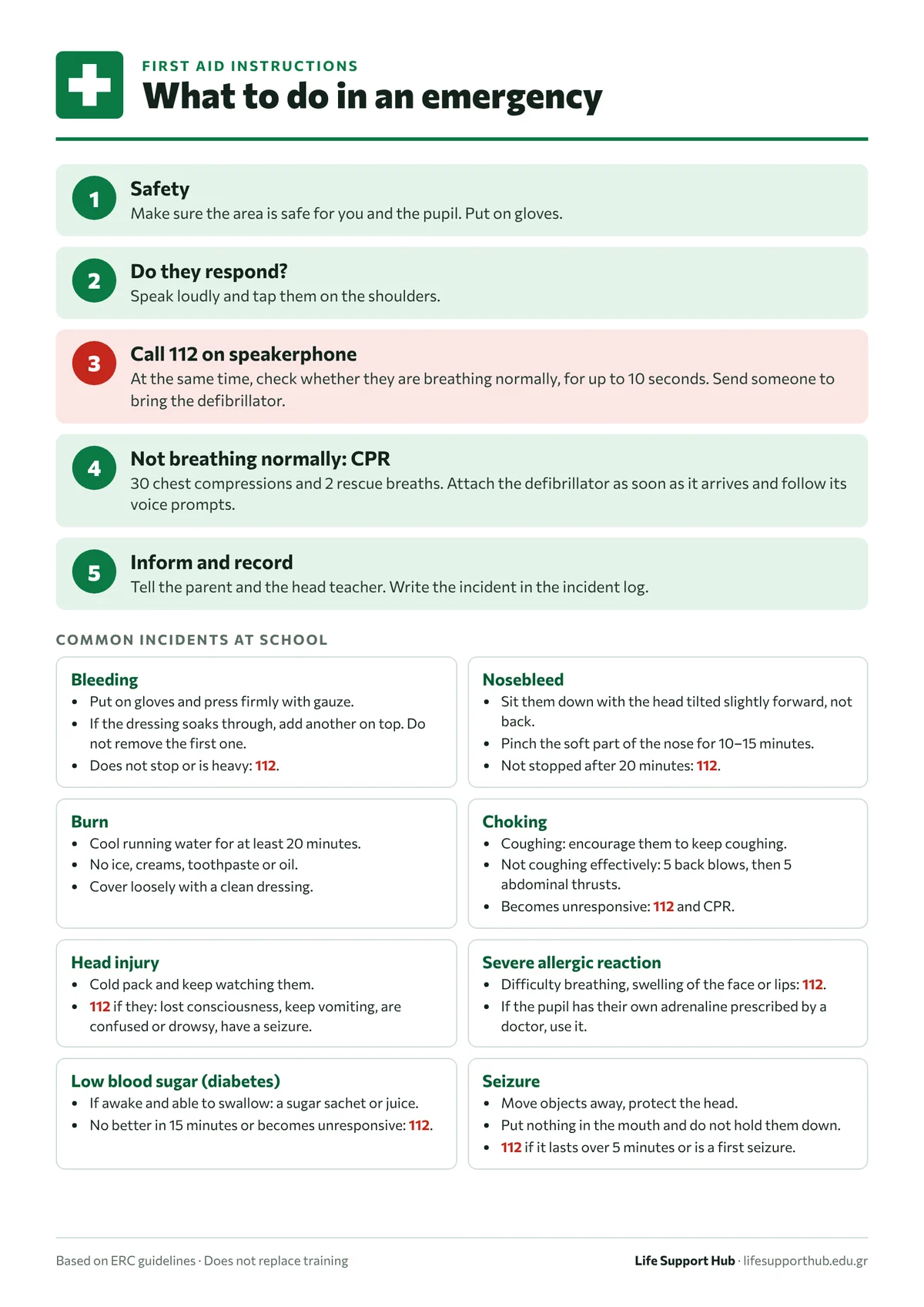
1. First aid instructions. The five steps for any emergency and eight incidents that often happen at school, from nosebleeds to seizures. Put it up next to the kit.
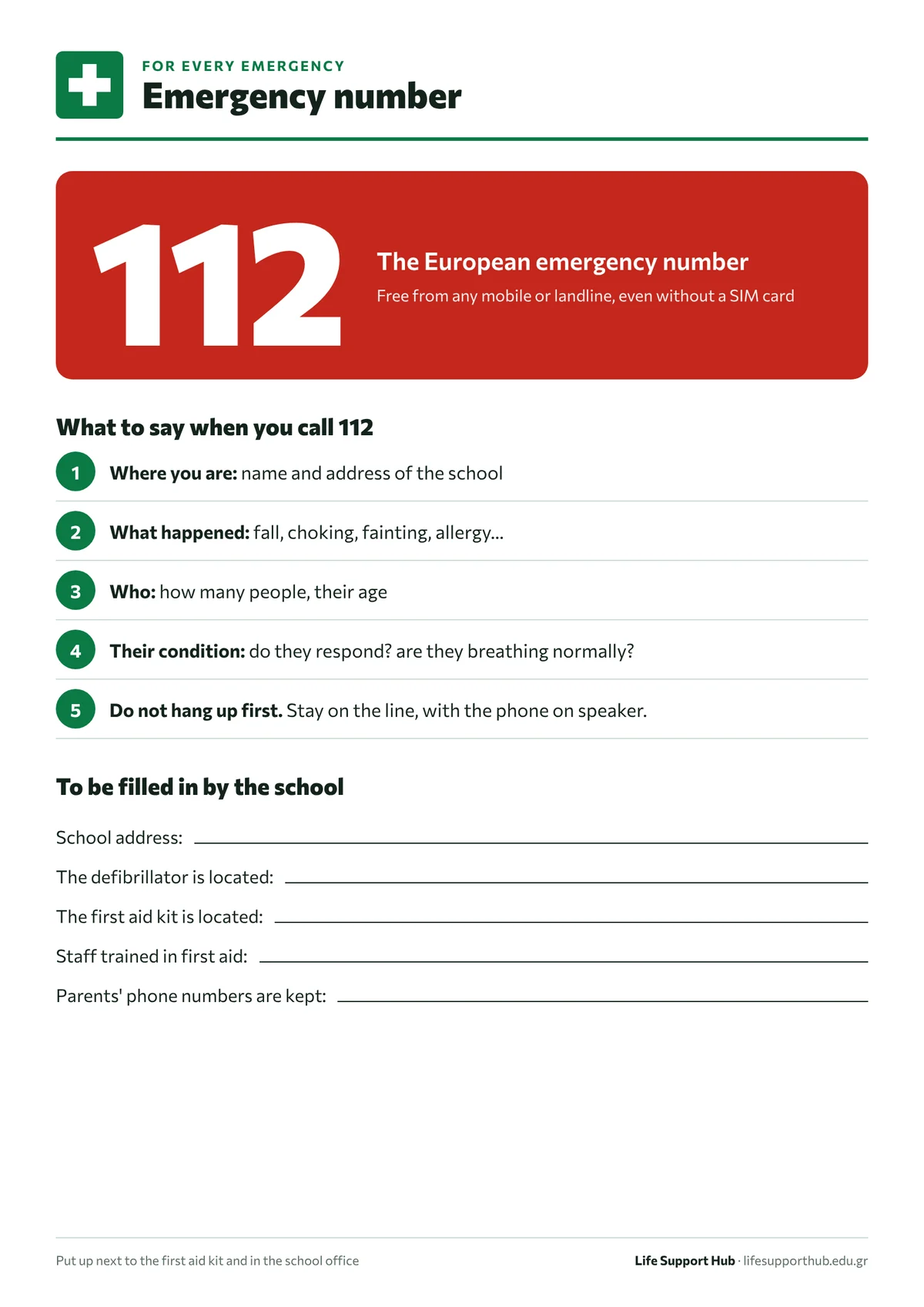
2. Emergency number. 112 and what to say when you call. The school fills in its address and where the defibrillator and the kit are kept. Under stress the address is easy to forget, so it is written down.
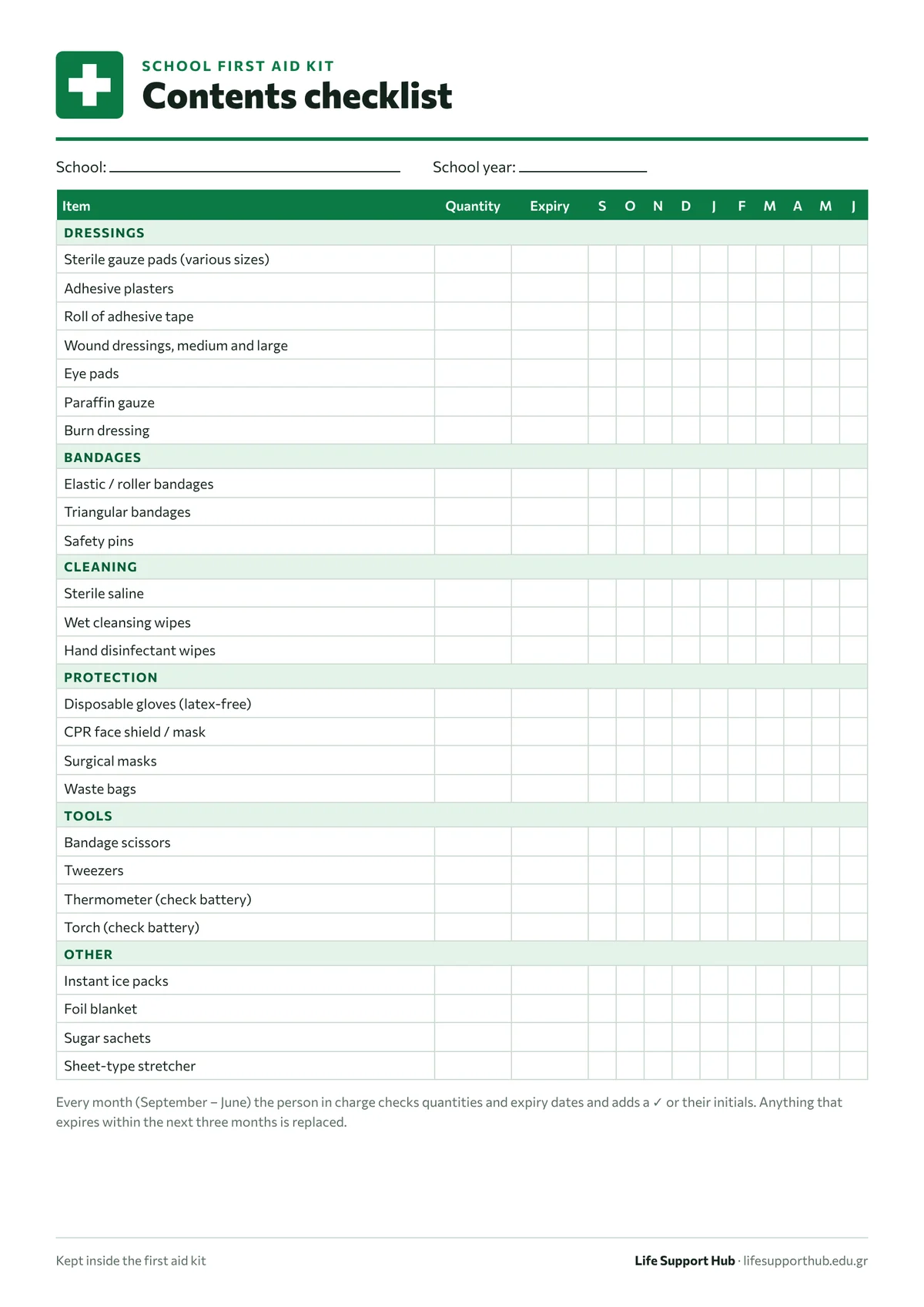
3. Contents checklist. Every item with columns for quantity, expiry date and a monthly check from September to June.
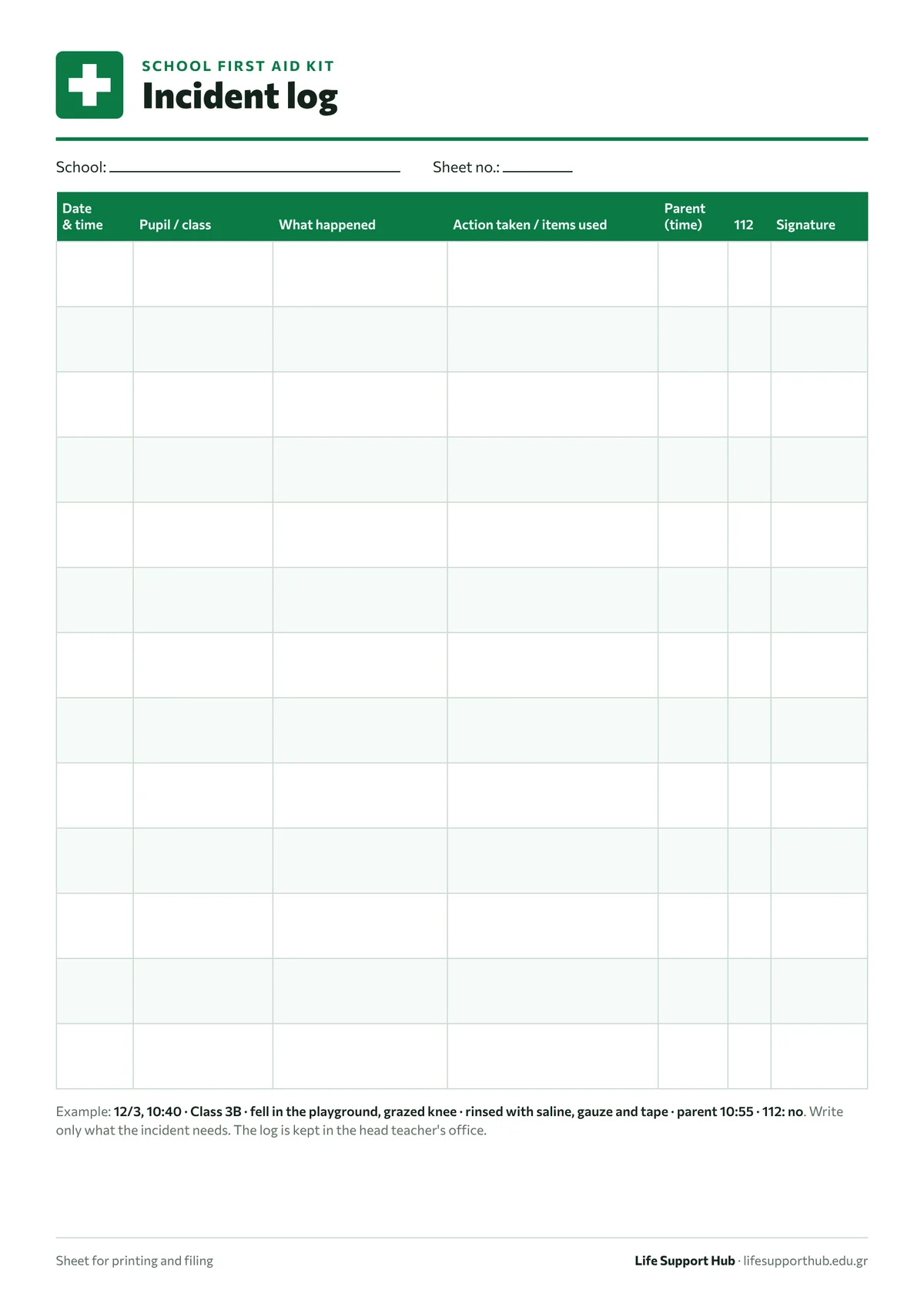
4. Incident log. Each time the kit is used, write down what happened, what was used and when the parent was told. This also tells you what to restock.
Wall-mounted and portable kits: what to look for
A school needs one large wall-mounted cabinet and one bag for trips. It costs less to buy an empty case and fill it from the list than to buy a ready-made box that lacks some items.
The wall cabinet should be at least 46 x 30 x 14 cm to fit everything. Small 30 x 23 cm cabinets are enough for an additional kit in a lab or gym. If it has a lock, keep the key where every teacher knows to find it, because nobody should be searching for a key in an emergency.
Who checks the kit and how often
Appoint one teacher to check the kit once a month against the contents checklist. Anything that expires within the next three months is replaced. After each incident, the used items are restocked.
Every September:
- Check all expiry dates
- Batteries in the thermometer and torch
- Defibrillator pads and battery
- New list of pupils who have their own medicines
- Update the 112 poster with the names of trained staff
A first aid kit helps only as much as the person next to the pupil knows how to use it. Life Support Hub trains teachers in first aid and CPR with ERC certification. For a programme at your school, email us at info@lifesupporthub.edu.gr.
Sources
- Cyprus Ministry of Education, circular on first aid and medicines in schools, 20/1/2023
- France, Protocole national sur l'organisation des soins et des urgences, BO hors-série n°1, 6/1/2000
- Germany, DGUV Information 202-059 "Erste Hilfe in Schulen"
- United Kingdom, BS 8599-1:2019+A1:2026
- Austria, Jugendrotkreuz: school first aid box to ÖNORM Z 1020
- Greek Ministry of Education, guidelines on giving medicines to pupils
From reading to doing
These steps are taught and practised hands-on in our seminars.
All training programmes →